One of the most common methods of finding support and resistance levels for stocks, commodities, futures and forex markets.
Pivot point or Pivots Level is a price level of significance in technical analysis of a financial markets that use the previous bars' highs, lows and closings to project support and resistance levels for future bars. It is the set of intra day support and resistance levels was originally used by stocks and futures floor traders as a simple way to have some idea of where the financial market was heading during the course of the trading day with only a few simple calculations. Pivots Levels equation expounds the theory that today's intra day support and resistance of trading instrument can be predicted using yesterday's volatility. Because so many market makers and professional traders follow pivot points you will often find that the market reacts at these levels which make this indicator predictive as opposed to lagging indicators such as Moving Average.
Trading above or below the pivot point indicates the overall market sentiment. It is a leading indicator providing advanced signaling of potentially new market highs or lows. By its nature Pivots is a technical analysis indicator for intra day trading and can be used in fx currencies trading as well as on any major financial market. All we need is a properly designed technical indicator to reflect the fact that forex is an on going market.
How to calculate Pivot Points
By traditional definition, the prices used to calculate pivot points are the previous day's high, low and closing prices for a financial instrument as follows:
Central Pivot Point (P) = (High + Low + Close) / 3
Support and resistance levels are calculated using the following formulas:
Resistance:
R1 = Resistance Level 1 = (2*PP) - L
R2 = Resistance Level 2 = (PP-S1) + R1
R3 = Resistance Level 3 = (PP-S2) + R2
Support:
S1 = Support Level 1 = (2*PP)-H
S2 = Support Level 2 = PP - (R1 - S1)
S3 = Support Level 3 = PP - (R2-S2)
Full set of support-resistance levels in this system includes also the mid points between each of those levels:
MR1 = (P + R1)/2
MR2 = (R1 + R2)/2
MR3 = (R2 + R3)/2
MS1 = (P + S1)/2
MS2 = (S1 + S2)/2
MS3 = (S2 + S3)/2
Where:
H = previous trading day’s high
L = previous trading day’s low
C = previous trading day’s Close
There is also the popular modification of the traditional Pivot formulae:
Central Pivot Point (P) = ((Today's O) + Yesterday's (H + L + C)) / 4
As you noticed opening price is not being used in pivots calculations formula.
Using this definition of Pivot and Support /Resistance levels as they calculated above trader can get different sets of the Pivot Points. Some traders suggest that this set works better, however you should remember that most of Pivot points indicators designed for Metatrader or Metastock use traditional Pivot Points formula.
Yet another pivot point system was developed by Tom DeMark, a famous technical analyst and president of Market Studies, Inc. This system uses the following rules:
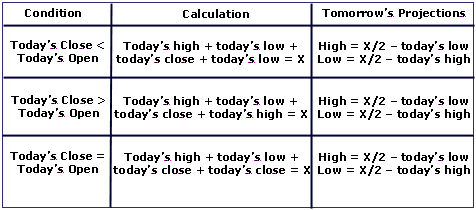
Trading Forex with Pivot Points
Many strategies can be developed using the pivot level as a base and it is important to understand the logic of using this instrument.
The pivot point is seen as the primary support or resistance level within the trading day. The two next most important pivot points are R1, S1. Mid points MR1 and MS1 are useful as stop-loss levels. The intra day trading movements usually occur between the pivot point and the first support or resistance levels because a multitude of traders play this range.
The best opportunity to open buy position is when the price consolidates little above pivot level with ascending daily trend (the pivot in this case is the basic support level) and the best opportunity to to open sell position is when the price consolidates little below pivot level with descending daily trend (the pivot in this case is the basic intra day resistance level). R1 or S1 level in this scenario is considered as the main target and closing price for intra day trading.
But in certain conditions of strong trend development these levels should be treated as initial targets on the way to R2 or S2. However in most cases these levels usually indicate market overbought or oversold areas accordingly and price movement loses its momentum in the area MR2 or MS2 levels. In this situation momentum indicator can help to get clearer picture: if we are long and the price in the MR2 area but momentum reversed to downtrend – it is most probably the time for closing or tightening protective stop. Accordingly if we are short and the price in the MS2 area and momentum reversed to uptrend – it is most probably the sign to exit.
MR3 and R3 or MS3 and S3 level are being used only in cases of sudden and very strong movements as good potential reversal points.
The same logic can be applied to the correction phase of the daily trend. For example if daily uptrend started correctional movement down – S1 line marks potential support and reverse point for turning prices back to the main direction. Line S2 in this case can give much better chance to buy. MS2 and MS3 lines can be used as stop loss levels. The same is true for downtrend and R1and R2 lines as potential resistance levels and MR1 and MR2 lines as stop loss levels for correctional movement up. Playing this scenario is very important to compare R1, R2 or S1, S2 lines to Fibonacci Retracements and to nearest strong support/resistance levels. As more they coincide as better chances we have. R1, R2 or S1, S2 levels usually tend to coincide more or less with one of Fibonacci Retracements. However R3 or S3 levels very often stay beyond of level 61.8. In this case price correction reaching R3 or S3 levels above or accordingly below Fibo 61.8 may indicate a transformation of correctional movement into reversal movement with further continuation.
Considering range-bound intra day forex trading remember that intra day time frames are not big enough to produce a reliable price range itself, thus it is a good idea to always trade intra day ranges only in the direction of the current daily currency trend which automatically brings us to logic of using the Pivot Levels considered above.
Using this logic you can develop your own forex trading system combining Pivot Levels and other indicators.
Few examples of forex trading systems using Pivot Points
As an example I can mention a popular combination of the Pivots and MACD. The main idea of this method is to trade the Pivot Levels confirmed by divergence of MASD and price charts’ extremums.
Another popular system assumes that the accuracy of using pivot lines increases when Japanese candlestick formations can also be identified. For example, if prices traded around the Pivot Level for most of the session and then made a foray above to the R1 or R2 lines while simultaneously creating a reversal formation (such as a shooting star, doji or hanging man), you could sell short in anticipation of the price resuming trading back below the pivot point.
One of the most popular scalping systems uses the Pivot Levels system combined with the indicator called Camarilla. Read more about Camarilla and how to combine it with the Pivot Points.
Traders using Metatrader Platform can find very useful the indicator SDX-TzPivots created by Shimodax. This technical trading tool properly calculates Pivot Levels for forex market. It also contains Camarilla and some other interesting features for automated calculation and drawing levels. Just apply it to the price chart as usually.
Download SDX-TzPivots indicator and read how to set it up.
Download thousands forex indicators for Metatrader here
|

